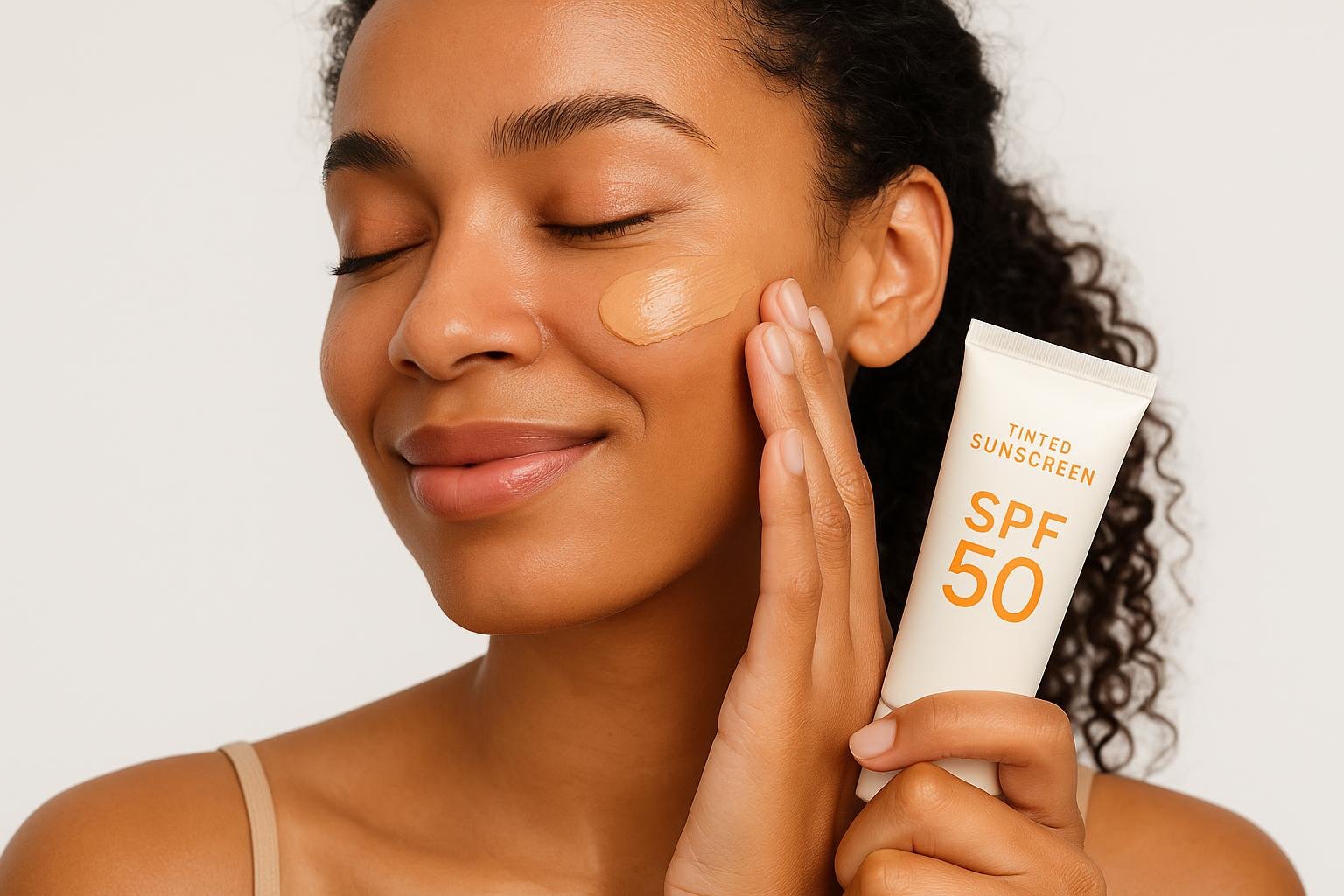
Tinted Sunscreens SPF 50 for Daily Wear: How to Choose a Glow Finish
Research-based guide · revised 23 October 2026
If you want a tinted SPF 50 for daily wear, the smartest choice is usually the one that gives you broad-spectrum protection, a tint you will actually wear consistently, and label details that match your routine. If dark marks, melasma, or visible white cast are major concerns, a tinted mineral formula that clearly mentions iron oxides deserves extra attention because the American Academy of Dermatology says tinted sunscreens can help protect against visible light and are often better for reducing white cast. “Glow” is a bonus, not proof of better protection.
What matters more than the word “glow”
For this category, there are two separate questions: does the sunscreen meet the basic protection standard you need, and does the tint/finish make daily use easier? According to the FDA, “broad spectrum” has a defined meaning on sunscreen labels, and water resistance should be stated as 40 or 80 minutes if a product makes that claim. The FDA also says sunscreens should not be marketed as “waterproof” or “sweatproof.”
The AAD recommends choosing sunscreen with SPF 30 or higher and notes that tinted sunscreen can be especially helpful if you are trying to manage discoloration. In its melasma self-care advice, the AAD specifically points people toward broad-spectrum, tinted sunscreen because visible light can worsen melasma in some people, and many tinted formulas use iron oxides to help address that concern.
Who should prioritize tinted SPF 50
- You want less white cast: This is often a practical reason to choose tinted mineral sunscreen, especially on deeper skin tones. If that is your main concern, you may also want to read Best Sunscreens for Dark Skin Tones No White Cast 2026.
- You are dealing with melasma or post-inflammatory marks: The AAD’s guidance makes tinted sunscreen especially relevant here because of visible-light considerations and the common use of iron oxides in tinted formulas. That does not mean every tinted sunscreen is equally suited to that goal.
- You want fewer morning steps: A glowy tint can partly replace a light complexion product for some users, but it is still sunscreen first, not makeup first.
Two exact SPF 50 tinted options with source-backed distinctions
| Product variant | What the source clearly states | Why that matters | Reason to skip |
|---|---|---|---|
| La Roche-Posay Anthelios Mineral Tinted Sunscreen for Face SPF 50 | 100% mineral; includes iron oxides; subtle blendable tint; positioned for no white cast/healthy glow; suitable for sensitive skin; four shades listed: Tinted, Medium, Medium-Deep, Deep. | The iron oxide mention lines up more directly with AAD guidance for people concerned about visible light and pigmentation. Multiple shades are more practical than a single “universal” tint. | If you need a clearly confirmed water-resistance claim from the product page before buying, the retrieved source did not verify that detail, so you should check the Drug Facts label yourself. |
| Clinique UV Solutions Brightening + Tinted Sunscreen Broad Spectrum SPF 50/PA+++ | 100% mineral; zinc oxide and titanium dioxide; four flexible tints; soft glowy finish; 1.4 fl oz / 40 ml; fragrance free; dermatologist developed/tested; ophthalmologist tested; photo-allergy tested; non-acnegenic. | This page gives more sensitive-eye and sensitive-skin positioning than many product listings. The stated size also helps when comparing value across brands. | If your priority is visible-light guidance tied specifically to iron oxides, the retrieved page did not clearly confirm that feature, so it is a less direct match for that use case than the La Roche-Posay option. |
How to choose between them
Choose La Roche-Posay first if…
You specifically want a tinted mineral SPF 50 with an explicit iron oxide claim and a product page that frames the tint as part of reducing white cast. That makes it the cleaner fit for someone whose shopping question is not just “Which one looks glowy?” but “Which one better matches dermatologist guidance for discoloration-aware daily wear?”
Choose Clinique first if…
You care more about comfort signals around eyes, fragrance-free positioning, or you prefer a softer makeup-like finish from a 100% mineral formula. Its source page gives more testing language, which may matter to shoppers who are deciding between a face sunscreen and something that has to work close to the eye area.
A practical checklist before you buy
- Check the exact label: broad spectrum should be clearly stated. If you want one sunscreen for errands plus outdoor sweat exposure, look for a water-resistance statement on the label, not just marketing copy.
- Decide whether visible-light coverage matters to you: if you have melasma or lingering dark marks, the AAD’s melasma guidance makes a tinted sunscreen a more targeted category than a standard untinted SPF.
- Do not overvalue skincare extras: niacinamide, antioxidants, or “brightening” language may be nice features, but they do not prove better sun protection than another broad-spectrum SPF 50.
- Look at shade flexibility: four shades is materially different from a single tint if you are trying to avoid ashiness or a makeup-mask look.
- Compare delivered value carefully: if one sunscreen is 40 ml and another is 50 ml, equal shelf prices would not mean equal value. A simple hypothetical example: if Product A costs $30 for 40 ml, that is $0.75 per ml; if Product B costs $34 for 50 ml, that is $0.68 per ml. Add shipping and taxes before calling one “cheaper.”
Worked example: picking for daily city wear vs outdoor wear
Say you want one tinted sunscreen mainly for commuting, office days, and casual daylight exposure, and your biggest annoyance is mineral white cast plus lingering post-breakout marks. On the source-backed facts available here, La Roche-Posay’s tinted mineral SPF 50 is easier to justify because the page explicitly mentions iron oxides and multiple shades. If, instead, your main concern is a fragrance-free mineral tint with eye-area reassurance signals and a soft glowy finish, Clinique becomes easier to justify.
But if your real-life routine includes running, beach use, or long sweaty walks, stop comparing finish first and verify water resistance on the Drug Facts panel. The FDA and AAD both make label details more important than marketing words in that situation.
Limits and where this guide should stay cautious
This comparison is based on manufacturer documentation and professional guidance, not independent wear testing. That means it cannot verify real-world pilling, oxidation, all-day shine control, or whether a given shade disappears perfectly on your skin. Manufacturer ingredient callouts also do not prove one finished sunscreen prevents more pigmentation than another in head-to-head use.
If you have melasma, very reactive skin, a history of skin cancer, or you are trying to build a discoloration routine around sunscreen, it may help to pair this guide with dermatologist-led advice and with adjacent care choices such as Best Vitamin C Serums for Hyperpigmentation & Glow only if that fits your routine. If your main issue is dryness under mineral sunscreen, Best Face Oils for Dry Skin 2026: Glow & Barrier Repair may be more relevant than chasing a shinier SPF finish.
Next actions
Narrow your choice by answering three questions: do you need visible-light-aware tint support, do you need clearly stated water resistance, and do you want a subtle skin-like tint or a more obviously glowy finish? Then check the exact product label, shade range, and size before purchase. That approach will usually lead to a better daily sunscreen decision than shopping by “daily glow” claims alone.
Sources checked for this guide
- American Academy of Dermatology: Understand sunscreen labels
- American Academy of Dermatology: Melasma self-care
- FDA: Tips to Stay Safe in the Sun: From Sunscreen to Sunglasses
- La Roche-Posay Anthelios Mineral Tinted Sunscreen for Face SPF 50
- Clinique UV Solutions Brightening + Tinted Sunscreen Broad Spectrum SPF 50/PA+++
Compare current listings
As an Amazon Associate, MySeekly earns from qualifying purchases. These links open Amazon US search results, not verified exact listings. Check the current variant, seller, regional label and delivered cost. You do not need to purchase a product to use this guide.
Search Amazon US for tinted mineral sunscreen SPF 50 face
Search Amazon US for iron oxide tinted sunscreen SPF 50
Research-based editorial guidance, not a hands-on product test or a medical review. Product photos and illustrative images do not show our own test results. Read our editorial approach.